

Pennsylvania has one building code, and it applies everywhere. There is no county you can drive to where nothing is required.
What varies is who administers it — and that is where the money is.
Compare Prices & Save
Most kits run $16–$20 per sq ft. Your real number depends on size, location, foundation & finish. Takes two minutes to find out.
14,068 kits sold 50-year Structural Warranty
Every municipality in Pennsylvania elects whether to enforce the Uniform Construction Code itself, or to decline. Roughly nine in ten have opted in. The ones that have opted out are overwhelmingly small and rural, which is to say they are exactly the townships where people buy land for a shop or a barndominium.
And here is what almost everyone gets wrong about them. Opting out does not repeal the code in that township. The code still applies to your building in full. What changes is that nobody is provided to enforce it — so you hire and pay the inspector yourself.
That is the opposite of the assumption most buyers arrive with.
Then there is the second problem, and it is the one that actually costs money: Pennsylvania will not tell you what snow load to build to. The state has said so in writing.
This page covers what a metal building costs in Pennsylvania, how to find out who inspects your project, the snow load the state refuses to publish, the farm exemption and the one word that destroys it, and the mine subsidence coverage that does not extend to your new building.
What a Metal Building Costs in Pennsylvania
Steel ships at essentially one national price. What changes state to state is the concrete and the erection labor — and Pennsylvania sits within about 2% of the national average.
| Size | Sq ft | Kit only | Turnkey in Pennsylvania | Turnkey national avg |
|---|---|---|---|---|
| 30×40 | 1,200 | $21,000 – $24,700 | $29,300 – $34,500 | $29,500 – $34,700 |
| 40×60 | 2,400 | $39,400 – $46,300 | $56,600 – $66,500 | $57,000 – $66,900 |
| 50×100 | 5,000 | $76,400 – $89,700 | $113,400 – $133,200 | $114,200 – $134,100 |
| 60×120 | 7,200 | $105,900 – $124,400 | $160,100 – $187,900 | $161,200 – $189,200 |
Kit-only covers the delivered steel structure — frame, roof and wall panels, doors, and engineering stamped for your jurisdiction. Turnkey adds the concrete foundation and professional erection.
Two things push Pennsylvania up toward the national average rather than below it, and both are worth knowing before you get a quote.
Footings go deep. Published frost depths across Pennsylvania jurisdictions run from 36 to 48 inches — three to four times an Arkansas or Texas footing. That is more excavation, more concrete and more labor on precisely the line item that varies by state, and it is the honest reason a Pennsylvania quote reads higher than a Tennessee one for the same building.
And in an opt-out township you pay for inspection directly. In most states that cost is buried in a permit fee. Here it can be a line item you write a check for. Budget for it rather than discovering it.
Philadelphia and Pittsburgh run above this table. Rural central and northern Pennsylvania run below it.
Price a building your size · The size-by-size price list
Who Inspects Your Building — and Why It Might Be You Who Hires Them
Pennsylvania’s Uniform Construction Code applies to construction, alteration, repair and occupancy of all buildings in the Commonwealth. That part does not vary.
What varies is administration, and there are two paths.
If your municipality opted in
Straightforward, and it is the common case. You apply to the township or borough, they review the plans, their code official or a third-party agency under contract to them does the inspections. This is how roughly nine in ten Pennsylvania municipalities operate.
If your municipality opted out
The responsibility moves onto you, and it splits by building type:
| What you are building | Who is responsible | Who they hire |
|---|---|---|
| A house, a two-family dwelling, or a utility and miscellaneous structure | The permit applicant — you | A construction code official or a certified third-party agency |
| Anything else — a shop, a warehouse, a commercial garage | The owner — you | The Department of Labor & Industry, or a third-party agency under contract to L&I |
Read that table twice, because it is the whole point. In an opt-out township, the building still has to comply, still gets inspected, and still needs the paperwork. You are simply the one who has to go find the inspector, engage them, and pay them.
The failure mode is a buyer who hears “our township opted out” and concludes that nothing is required. He builds. Then he needs a certificate of occupancy for a lender, an insurer or a buyer, and discovers there is no permit record and no inspection trail, because he was supposed to create one and did not know it. That cannot be reconstructed after the drywall is up.
How to find out which one you are in
Labor & Industry publishes a downloadable list of all 2,562 Pennsylvania municipalities with each one’s opt-in or opt-out status, effective date, and the building code official’s name and phone number.
That is a two-minute lookup and it settles the single most important question about your project. Do it before you buy land, not after you order steel.
The Snow Load Pennsylvania Refuses to Publish
This is the most expensive thing on this page, and it is invisible until it is not.
Most states fill in the climatic and geographic design criteria — ground snow load, wind speed, seismic category, frost depth — either statewide or by county. Pennsylvania does not. The Department of Labor & Industry has said in writing that ground snow loads for Pennsylvania’s political subdivisions will not be developed and published by the Department.
Instead, from L&I’s own advisory:
“Design professionals are responsible for utilizing either the ground snow loads established per Figure 1608.2 of the International Building Code or for developing the ground snow loads for all areas designated as ‘Case Study’ areas in Pennsylvania.”
Two consequences follow.
First, the design criteria are set municipality by municipality — 2,562 separate answers, adopted in local ordinances.
Second, a great deal of Pennsylvania is designated “Case Study” on the national map, which means the map gives no number at all and your engineer has to develop one from scratch. And the advisory adds a detail that matters: assistance in developing snow loads in a case study area cannot be obtained from the federal cold regions laboratory that used to provide it.
What the numbers actually look like
Verified from Pennsylvania jurisdictions’ own published documents:
| Jurisdiction | Ground snow | Frost depth |
|---|---|---|
| City of Reading, Berks County | 25 psf | 36 in |
| Central Keystone COG (six central counties) | 35 psf | 40 in |
| Indiana County | 35 psf | 36 in |
| Mount Pleasant Township, Westmoreland County | 40 psf | 36 in |
| Fairview Township | 40 psf roof | 48 in |
25 psf in the southeast to 40 psf in the west, in a state you can drive across in six hours. And parts of the northern tier and the Poconos are case-study areas where the number is whatever a qualified engineer determines it to be.
How this goes wrong
You call a national manufacturer. The configurator asks for a snow load. You do not have one, because nobody has given you one, so the manufacturer uses a regional default — commonly 20 or 30 psf. That is right for the Philadelphia suburbs and wrong for most of the state.
The building gets engineered and priced. You pay a deposit. Then you go to the township and are handed a table that says 40 psf.
Primary frame members are now undersized. Purlin spacing changes. Sometimes the frame line spacing changes, which changes the anchor bolt layout, which changes the foundation. It is a re-engineering and a re-quote at current steel pricing, arriving after your deposit, at the point where your leverage is gone.
One more warning, and it is uncomfortable
The design criteria you are handed were written into an ordinance by a municipality, not by a structural engineer, and they sometimes contain errors. At least one Pennsylvania township publishes a table with a seismic design category and a mean annual temperature that are both implausible for its own county — almost certainly transcription mistakes carried forward for years.
So: get the filled-in design criteria in writing from the code official, and have your engineer sanity-check them before you order steel. Not after.
That single request — ground snow load, design wind speed, seismic design category, frost depth, in writing — is the highest-value five minutes you will spend on a Pennsylvania project.
The Farm Exemption, and the One Word That Ends It
Pennsylvania’s agricultural exemption is genuinely broad, and it is broader than most states in one specific way that is worth understanding.
The Uniform Construction Code simply does not apply to agricultural buildings. The statutory definition covers a structure used to store farm implements, hay, feed, grain or other agricultural or horticultural products, or to house poultry, livestock or other farm animals, along with milk houses and mushroom-growing structures.
What makes it unusually broad: the test is entirely what the structure is used for. There is no acreage requirement, no minimum parcel size, no farm-income test, and no requirement that the land be enrolled in any preferential tax program. Many states gate their agricultural exemption on acreage or on proving agricultural income. Pennsylvania does not.
But three things end it, and they are written into the definition itself.
1. Habitable space. The definition says the term “shall not include habitable space.” This is the one that catches people. A shop with an office, a bathroom and a place to sleep is not an agricultural building. A barndominium is not an agricultural building, and no amount of farming on the parcel changes that.
2. Processing, treating or packaging. Storing what you grew is agricultural. Processing it in the building is not.
3. Becoming a place of occupancy by the general public. Agritourism, event barns, wedding venues, retail floors — all outside the exemption.
What the exemption does not cover
It exempts you from the building code. It does not exempt you from anything else. Municipal zoning still applies: setbacks, height limits, lot coverage, use districts. Floodplain regulation still applies. And stormwater rules apply on their own trigger, covered below.
There is a telling detail in the statute worth knowing: pole barns on agricultural fairgrounds are exempt except that electrical service still requires a permit and inspections. The legislature has been willing to pull services back under permit even inside an exemption — so do not assume an exemption covers your electrical work.
A separate exclusion worth knowing about
Structures under 1,000 square feet accessory to a detached one-family dwelling are outside the Uniform Construction Code entirely — carports, detached private garages, greenhouses, sheds.
That is a real and underused exemption. A 24×40 detached garage on a house lot is 960 square feet and needs no permit under the UCC. Zoning still applies, so check setbacks. But the building code does not reach it.
The Farm Building Decision That Costs You Twice
This deserves its own section because the two consequences are unrelated and buyers walk into both at once.
Much of Pennsylvania’s farmland is enrolled in Clean and Green, the preferential tax assessment program that taxes land on its use value rather than its market value. It is a substantial saving and most owners of enrolled land want to keep it.
Putting habitable space into a building on enrolled ground does two separate expensive things.
It destroys the agricultural exemption under the building code, as above — so the building now needs full permitting and inspection.
And it can trigger rollback taxes on the acres converted to residential use: seven years of the difference between what you paid and what you would have paid at market value, plus 6% simple interest per year.
A landowner may split off a limited amount of land each year for residential construction without triggering rollback on the remaining enrolled acreage, subject to cumulative caps. The point is that this is a decision with tax consequences, and it should be made with the county assessment office on the phone rather than after the fact.
One design decision — adding living quarters — changes the building’s regulatory status and the parcel’s tax status simultaneously. Know that before you draw the floor plan, not after.
Contractors: What Pennsylvania Does and Does Not License
Pennsylvania’s approach is unusual and worth stating plainly, because it changes how you should vet people.
There is no state contractor license of any kind. And unusually, there is no state electrician license, no state plumber license, and no state HVAC license either. Those trades are licensed municipally in Pennsylvania, if at all — so the requirement genuinely depends on which township you are in.
What is registered or licensed at the state level:
- Home Improvement Contractor registration with the Attorney General, required for anyone performing more than $5,000 of home improvements in a calendar year. There is an important boundary here: new home construction is excluded. So an erector putting a shop or garage up at your existing house is doing a home improvement and must be registered. The same erector putting the first structure on a bare lot is not covered.
- Crane operator licensure through the Department of State — and this one is directly relevant to steel erection. If a crane is setting your frames, the operator needs a Pennsylvania license.
Registration is not competency. A Home Improvement Contractor number means the contractor gave the Attorney General a name, an address and a certificate of insurance. It says nothing about whether they have ever erected a clear-span steel building.
So do the verification the system will not do for you:
- Ask for clear-span steel erection references specifically. Erecting a rigid frame is a different trade from framing a house, and a crew that has only done wood will tell you it is the same.
- Get the certificate of insurance directly from the insurer, not forwarded by the contractor.
- Confirm the crane operator’s Pennsylvania license if a crane is involved.
- Ask what frost depth they build to and how they know. In Pennsylvania the answer should be a number from your municipality’s adopted criteria, not a habit.
- Get the anchor bolt plan before the slab is poured. More projects go wrong at this handoff than anywhere else.
Buying the building direct at wholesale and contracting the slab and the erector separately is what you actually save working in your favor, and Pennsylvania puts no state licensing barrier in front of it.
Mine Subsidence: Your House Policy Does Not Cover Your New Shop
If your land is over old coal country — and abandoned underground coal and clay mines underlie 43 of Pennsylvania’s 67 counties — this section is worth five minutes.
Standard homeowners policies exclude mine subsidence. Pennsylvania runs a state Mine Subsidence Insurance program to fill that gap, and it is inexpensive: coverage from $5,000 to $1,000,000 per structure at roughly 27 cents per $1,000 of coverage — about $44 a year on $160,000 of coverage.
Three things about it that catch people:
It is opt-in. Unlike some neighboring states where the endorsement is added automatically unless you decline it in writing, in Pennsylvania nothing happens unless you apply. If you have not applied, you are not covered.
A separate policy is required for each building. This is the trap. You erect a $90,000 steel shop next to an insured house and assume the coverage extends. It does not. The shop needs its own policy.
An inspection may be required before you can buy it. Buildings in areas with a record of past or recent subsidence problems have to be inspected before coverage is issued — which makes this a pre-construction diligence item, not a post-construction errand. Find out whether your parcel is in one of those areas before you pour concrete.
The state provides mapping tools to check eligibility for a specific address.
Stormwater: A Different Agency, on a Different Timeline
This is the requirement out-of-state buyers miss most reliably, because it has nothing to do with the building code official and nothing to do with the building.
A written erosion and sedimentation plan is required at 5,000 square feet of earth disturbance, and a full stormwater permit at one acre. These are administered by County Conservation Districts — a separate agency, with its own review timeline, that your township building office will not mention.
Five thousand square feet is smaller than it sounds. A 40×60 building is 2,400 square feet of footprint, but the disturbance includes the apron, the driveway extension, the laydown area and anywhere equipment tracked. Most projects of this size clear it comfortably.
And the agricultural exemption does nothing for you here. Different statute, different agency, no farm carve-out for the earth disturbance thresholds.
Call your county conservation district early. The requirement is manageable; the schedule surprise is not.
Climate, Insulation and the Foundation
Pennsylvania spans a real range — humid summers everywhere, and winters that get considerably more serious as you move north and west.
Condensation is the practical problem in a steel building here, and Pennsylvania gives you both mechanisms. In a heated building, warm interior air meets cold steel. In an unheated one in spring, warm humid outdoor air meets steel still cold from the night. Both put water on the underside of the roof panel, and the owner usually concludes the roof is leaking when it is not.
The fix is the same either way: a vapor barrier facing the interior, continuous and correctly lapped, plus ventilation. Specify it at order time — retrofitting it costs far more than including it.
Insulation is a two-season purchase in Pennsylvania, not a one-season one. See insulation types.
On the foundation, the frost depth is the headline — 36 to 48 inches depending on your municipality — but it is not the whole story. Pennsylvania has significant limestone geology in the Lehigh and Cumberland valleys, and clay soils elsewhere that move seasonally. On anything larger than a small shop, a soils investigation is money well spent. See foundation requirements.
Radon: Not Required, and Worth Doing Anyway
This one is worth publishing because the usual assumption runs backwards.
Pennsylvania’s statewide building code does not require radon-resistant new construction. The Department of Environmental Protection says so directly, and the relevant model code appendix is not adopted.
But the average residential radon concentration in Pennsylvania is 7 to 8 picocuries per liter, against a federal action level of 4 — roughly double the threshold, as a statewide average. Some municipalities require radon-resistant construction by local ordinance even though the state does not.
For a barndominium or any building you intend to live in, this is worth doing regardless of whether anyone makes you. Passive radon control during construction is gravel, sheeting, a sealed slab and a vent pipe — a few hundred dollars. Retrofitting it into a finished slab-on-grade steel building is several thousand and considerably more disruptive.
Check whether your municipality requires it. Then do it anyway.
Metal Building Homes in Pennsylvania
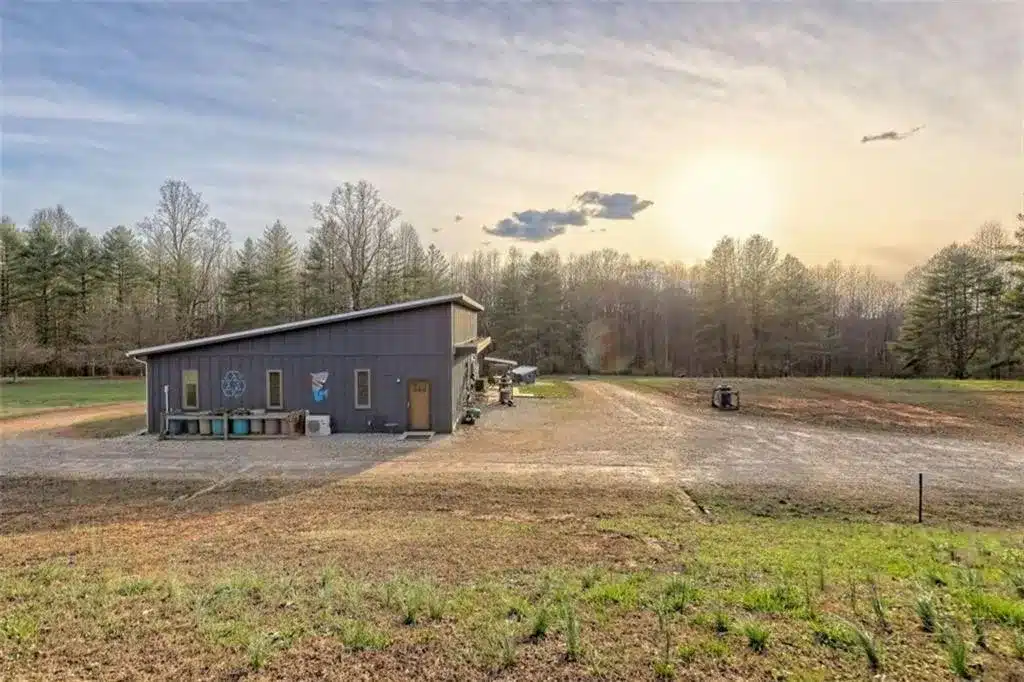
Pennsylvania is a solid barndominium market — a lot of rural acreage, an established agricultural building culture, and land prices that make the format make sense.
See barndominium designs, metal building residences and shop with living quarters for layouts.
Four things to settle early, in this order:
- Your municipality’s opt-in status, because it determines whether you or the township hires the inspector. If it is an opt-out township and you are building a dwelling, you engage a third-party agency yourself — and you should line that up before you break ground.
- The design criteria in writing, especially the ground snow load. You will live under that roof for thirty winters.
- The Clean and Green question, if the land is enrolled. Habitable space is what triggers both the loss of the farm exemption and potential rollback taxes.
- Financing and appraisal. Lenders treat steel-framed homes inconsistently and an appraiser needs comparable sales. Where barndominiums are common this is easy; where they are not, the appraisal is the long pole.
And a genuine advantage worth naming. Because Pennsylvania has no permitting gap — the code applies everywhere and someone always inspects — you finish with a full permit and inspection record and a certificate of occupancy. In several states covered in this series, buyers in unregulated counties discover at closing or refinance that no such document exists and cannot be created retroactively.
Pennsylvania asks more of you up front. It also hands you a clean file at the end, and that file is worth real money the day you sell or refinance.
Popular Uses for Metal Buildings in Pennsylvania
Farm shops, equipment storage and hay barns. Pennsylvania has roughly 50,000 farms, and the agricultural exemption makes a genuine farm building unusually straightforward to put up here.
Dairy and livestock buildings. Pennsylvania is a major dairy state, and free-stall barns, milking parlors and heifer housing all suit clear-span construction.
Equestrian barns and covered arenas. Chester, Bucks and Lancaster counties support a serious horse economy, and a clear-span covered arena is what turns a short outdoor season into a year-round one.
Distribution buildings along the I-78, I-81 and I-80 corridors. The Lehigh Valley and central Pennsylvania have become one of the largest logistics markets in the country, and clear-span steel is the default.
Heated workshops. In a state with a real winter, an insulated shop with a concrete floor and a heater is one of the most common single requests — and specifying the insulation at order time rather than adding it later is the difference between a good building and an expensive lesson.
RV and boat garages. Tall-door buildings protecting assets that sit parked eight months a year.
Hangars for private aircraft and indoor sports buildings, both of which suit the clear spans this product does well.
The 40×60 is the most requested size in Pennsylvania, as it is nationally — see The 40×60 specification or all available dimensions.
Pennsylvania Metal Building FAQ
Do I need a permit for a metal building in Pennsylvania?
Almost certainly yes. The Uniform Construction Code applies to every building in the Commonwealth and there is no municipality where nothing is required. What varies is who administers it — your township if it opted in, or an inspector you hire yourself if it opted out. The main exceptions are genuine agricultural buildings and structures under 1,000 square feet accessory to a detached one-family dwelling.
My township opted out of the UCC. Does that mean no permit?
No, and this is the most costly misunderstanding in Pennsylvania. Opting out changes who enforces the code, not whether it applies. For a house or a utility structure, the permit applicant engages a certified third-party agency. For anything else, the owner goes to Labor & Industry or a third-party agency under contract to L&I. You still get inspected. You just have to arrange and pay for it.
What ground snow load should my building be engineered for?
The one your municipality has adopted — and Pennsylvania is one of the few states where the state government has said in writing it will not publish these. Verified values range from 25 psf in Reading to 40 psf in Westmoreland County, and much of the state is designated “Case Study,” meaning an engineer has to develop the number. Get the filled-in criteria table in writing from your code official before ordering.
Which code edition is Pennsylvania on?
Pennsylvania adopted the 2021 International Codes effective January 1, 2026. Anything you read describing Pennsylvania as a 2018-code state is out of date. Accessibility provisions remain at the 2018 version because of a court injunction.
Are farm buildings exempt in Pennsylvania?
Genuine agricultural buildings are exempt from the Uniform Construction Code, and the exemption is unusually broad — no acreage minimum, no income test. But it shall not include habitable space, does not cover buildings where products are processed, treated or packaged, and does not cover places of public occupancy. It also does not exempt you from zoning, floodplain rules or stormwater requirements.
Do I need a licensed contractor in Pennsylvania?
There is no state contractor license — and no state electrician, plumber or HVAC license either; those are municipal. Contractors doing more than $5,000 of home improvements per year must register with the Attorney General, though new home construction is excluded from that. Crane operators do need a state license, which matters if a crane is setting your frames.
Is mine subsidence insurance automatic?
No. Pennsylvania’s program is opt-in, and a separate policy is required for each building — a policy on your house does not cover a new shop. Coverage runs to $1,000,000 per structure at roughly 27 cents per $1,000. In areas with a history of problems, an inspection is required before coverage can be purchased, so check before you build.
What does a 40×60 metal building cost in Pennsylvania?
Roughly $56,600 to $66,500 turnkey, including foundation and professional erection, or $39,400 to $46,300 for the kit alone. Philadelphia and Pittsburgh run above that range.
How long does a metal building take in Pennsylvania?
Typically 12 to 20 weeks from order to completion. Fabrication is 6 to 12 weeks and erection is one to three weeks at this size. In an opt-out township, add time at the front for engaging your own inspection agency, and add time for the county conservation district if your earth disturbance exceeds 5,000 square feet.
Compare Prices On Pennsylvania Steel Building Kits & Save
Buy the building direct at wholesale and keep the margin a dealer would have added. Tell us your dimensions, your municipality, and what you are using the building for, and we will get you competing quotes from manufacturers who ship to Pennsylvania — engineered to your adopted snow load, not a regional default.
Send us your dimensions · Every state guide
Prices are estimates for planning purposes and vary with steel pricing, site conditions and local labor. Code editions, municipal elections and adopted design criteria all change — verify current requirements with your municipality or with the Department of Labor & Industry before ordering. This page is general information, not engineering advice.
Get Your Free Quote
Answer a few quick questions and we’ll match you with suppliers who quote your exact size and location. Takes about two minutes.
14,068 kits sold • 50-year structural warranty • Free, no obligation
